

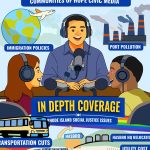

Communities of Hope Civic Media is building a healthier civic information ecosystem in Rhode Island—one that is rooted in equity, sustained by collaboration, and shaped by the people who have too often been excluded from it.
At its core, this work is about ensuring that everyone—especially those in the most vulnerable communities—has access to accurate, relevant, and actionable information, and the power to produce and share that information themselves.
A Civic Information System That Serves Everyone
Today, too many Rhode Islanders experience gaps in civic information: public meetings go uncovered, policies go unexplained, and entire communities remain underrepresented or misrepresented in local media. These gaps weaken public knowledge, reduce trust, and limit meaningful participation in civic life.
We are building an alternative.
Through our media platforms—radio, digital news, newsletters, apps, and community programming—and in partnership with local organizations and the Rhode Island News Collaborative, we are developing a coordinated system that produces, shares, and amplifies civic information where it is most needed. This system connects newsrooms, libraries, community centers, classrooms, and grassroots organizations to reduce duplication, share resources, and expand access.
From Audience to Ownership
A healthy civic information ecosystem does not treat people as passive audiences. It creates pathways for participation, leadership, and ownership.
At the center of this work is HOPE LAB, our flagship initiative to train and employ residents from underrepresented communities as documenters, storytellers, and civic leaders. Participants are paid to attend and document public meetings, court proceedings, and community events—producing information that is shared freely with the public and with local news outlets.
Over time, participants move beyond documentation to produce original reporting, oral histories, and multimedia storytelling. They mentor new cohorts, contribute to community education, and help shape how information flows within their own networks.
This model does more than expand coverage. It redistributes power—ensuring that communities are not only represented in the media, but are active producers and stewards of the information that affects their lives.
Building Career Pathways and Community Leadership
We are building a long-term pipeline for civic media leadership in Rhode Island.
Through training, mentorship, and paid opportunities, participants develop skills in journalism, media production, organizing, and civic engagement. They gain experience navigating institutions, understanding policy, and communicating across differences. By the end of the program, they are positioned as trusted connectors—individuals who can move between communities and institutions, translating knowledge, building relationships, and strengthening networks.
This work is especially focused on communities facing structural barriers, including immigrants and refugees, communities of color, individuals with disabilities, LGBTQIA+ communities, and those impacted by poverty, environmental injustice, and the criminal legal system.
Strengthening Networks, Not Silos
A healthy ecosystem depends on strong relationships.
We are building a collaborative infrastructure that brings together local news organizations, community-based groups, educational institutions, and civic partners. Through shared content, joint projects, and coordinated coverage, this network increases reach while reducing costs—making local information systems more sustainable over time.
Our work through the Rhode Island News Collaborative, and in partnership with the RWU Co-Lab, is designed to align efforts across the state: connecting journalism with education, community engagement with research, and storytelling with public action.
This networked approach allows us to respond more effectively to community needs, adapt to changing conditions, and develop new models for funding and sustaining civic media.
Expanding What Counts as Civic Information
Civic information is more than news coverage. It includes education, dialogue, culture, and lived experience.
We are building a system that transforms raw information—meeting notes, public records, community observations—into accessible and meaningful forms: multimedia journalism, social media, public exhibits, curriculum, and live events. We also create spaces for conversation, including depolarizing dialogues and listening sessions that bring people together across differences.
This approach recognizes that trust is built not only through information, but through relationships, visibility, and shared understanding.
A Model for Long-Term Change
Our goal is not a short-term intervention. We are building lasting capacity.
By investing in local talent, strengthening institutional partnerships, and developing shared infrastructure, we are creating a civic information ecosystem that can grow, adapt, and sustain itself over time. The model is grounded in practice, informed by research, and designed to be shared—so that lessons learned in Rhode Island can support similar efforts elsewhere.
The Future We Are Working Toward
We envision a Rhode Island where:
- Residents have consistent access to clear, relevant, and trustworthy civic information
- Communities see themselves accurately represented—and represent themselves
- Local media and community organizations collaborate instead of compete
- Civic participation is informed, inclusive, and ongoing
- Information systems strengthen health, equity, and democracy
This is what we are building: a civic information ecosystem that is not only more inclusive and representative, but more responsive, resilient, and just.